

Top 10 Prefabricated Substation Companies in China Worth Knowing
2026-11-02
China’s prefabricated substation market has moved from niche to necessity almost overnight. With grid upgrades, renewables, and industrial parks all demanding faster deployment, the companies that can deliver reliable, modular power units are suddenly in the spotlight. This list narrows down ten manufacturers actually worth your attention—including CNKEEYA, whose approach to compact substation design deserves a closer look.
How Chinese manufacturers are rethinking power delivery with modular substations
Chinese manufacturers are shifting away from sprawling, site-built electrical yards toward factory-assembled modules that arrive on trucks ready to plug into the grid. This approach cuts installation time from months to weeks and allows utilities to deploy capacity in phases. Instead of pouring concrete and wiring components outdoors under unpredictable weather, workers bolt together prefabricated sections inside controlled factory conditions, then ship them with control systems already tested and energized.
The real rethinking lies in how these substations are standardized yet flexible. Rather than treating each project as a unique engineering puzzle, manufacturers now offer a menu of standardized voltage tiers, protection schemes, and cooling options that can be combined quickly. Some factories even build multiple substation modules on a single assembly line, using common busbar connections and interchangeable relay panels. This modular logic lets a rural distribution upgrade share the same core components as an urban industrial feed, slashing spare parts inventories and training time for field crews.
Another shift is embedding intelligence directly into the modules. Chinese suppliers now integrate fiber-optic sensors, partial discharge monitors, and remote terminal units inside the factory-built enclosures, so the substation arrives not just as dumb steel and copper, but as a networked device that reports its own health. Utilities can watch thermal profiles and bushing leak currents from a control room, and swap out a degraded power module during a scheduled outage rather than rebuilding an entire bay. This turns power delivery from a bespoke construction project into a repeatable, field-upgradeable product line.
Inside the engineering choices behind factory-built switchyards
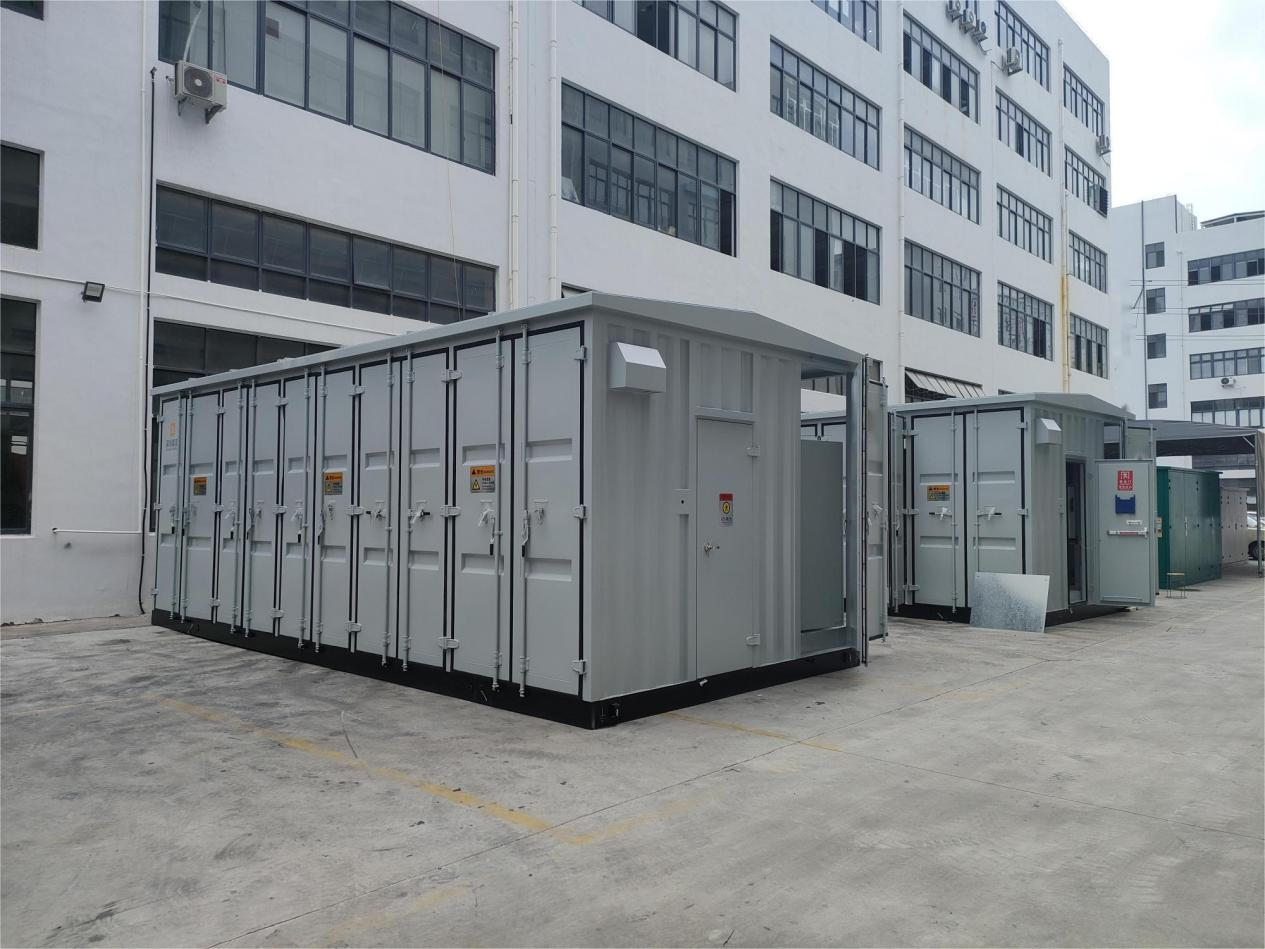
Factory-built switchyards compress what was once a sprawling field construction project into a controlled assembly line, but that shift only works when the engineering is tuned for transport and repeatability. Bus spans, support structures, and protection panels are broken into liftable modules that still preserve electrical clearances after bolting together on site. The geometry of each skid is driven as much by road-weight limits and shipping envelopes as by phase-to-ground spacing, so designers often use shorter bus runs, rigid bus instead of strain bus, and pre-tested junction boxes that reduce field wiring to a few plug connections.
A quieter set of choices happens around grounding, arc containment, and thermal behavior. Because the modules are tightly packed, grounding grids are pre-welded into the steel bases and verified at the factory rather than improvised in the field. Internal arc faults influence compartment venting and door latching, while cable trays and control conduits are routed to keep heat from transformers away from microprocessor relays. These decisions remove the usual site-by-site variability, but they also lock in assumptions about ambient temperature, altitude, and seismic drift that must be revisited for every project.
The result is less a collection of components and more a single engineered product. Relay settings, interlocking logic, and communication paths are bench-tested before shipping, so commissioning becomes a matter of confirming what was already proven. This approach favors standard arrangements: double-bus single-breaker schemes, compact AIS layouts, and outdoor enclosures with climate control. The trade-off is flexibility at the site; the gain is predictability in both schedule and fault response.
Profiles of ten domestic firms leading the prefabricated substation shift
Not long ago, a prefabricated substation was treated as a stopgap for remote sites or temporary loads. That assumption has collapsed under the weight of delivery schedules, labor shortages, and tighter grid reliability rules. Among domestic suppliers, ten firms have emerged as the clearest drivers of the change—not by issuing white papers, but by retooling their factories and shortening the path from order to energization. Their backgrounds span transformer winding, metal-clad switchgear, protection engineering, and turnkey contracting, yet the direction is the same: move complexity indoors, under controlled conditions, before it ever reaches a foundation.
The differences among these ten are more instructive than their similarities. One has pushed a 132 kV bay into a standard 40-foot enclosure, cutting site assembly to a matter of days. Another favors skid-mounted units that can be lifted onto a prepared pad and re-terminated within a week, which appeals to mining operators and renewable developers who may need to relocate assets. A third has focused on the unglamorous work of standardizing busbar penetrations and cable entry points, so that a 33/11 kV substation can be ordered with fewer custom drawings and fewer surprises during commissioning. Several others compete on factory test depth—partial discharge scans, thermal imaging under load, and protection relay injection tests are now routine before shipment.
The cumulative effect is visible in utility tender language and owner expectations. Buyers who once asked mainly about price now demand shorter lead times, witnessed factory acceptance tests, and remote monitoring readiness. The ten domestic firms have not all won the same market segments, and their commercial strategies diverge, but they share a willingness to absorb integration risk that used to fall on site contractors. That shift is quietly changing how grid capacity gets added: less dependence on weather windows, fewer field rework loops, and a much sharper definition of what counts as a complete substation at the factory gate.
Why remote and urban projects alike are turning to compact enclosures
Space comes at a premium in dense urban corridors, yet remote installations face an opposite problem: getting bulky equipment to the site without excessive cost or risk. Compact enclosures resolve both pressures by shrinking the physical package while keeping essential controls, power, and networking gear inside. A single pre-wired unit can be moved through narrow doorways, lifted onto a rooftop, or transported in the back of a pickup instead of a flatbed truck.
The smaller footprint also shortens the path from delivery to operation. There is less ground to clear, fewer concrete pours, and no need for permanent structures that trigger lengthy permitting reviews. In remote areas, where every kilogram of freight and every hour of skilled labor count, dropping in a compact enclosure often means the difference between a project that goes live in days and one that stalls for weeks.
Maintenance leans toward the practical side as well. Cables, breakers, and cooling components sit within easy reach, so a single technician can diagnose and swap parts without moving heavy panels or climbing through sprawling cabinets. This hands-on simplicity, paired with lower material and shipping costs, is pushing both off-grid and inner-city projects toward a smaller, tighter build philosophy.
The quiet advantage of pre-tested, plug-in power infrastructure
Most data center conversations fixate on what can be measured at a glance: capacity, latency, redundancy. What rarely gets mentioned is the hidden cost of on-site assembly. Pre-tested, plug-in power infrastructure sidesteps that entirely. Components arrive already mated, wired, and load-banked, so the usual discovery of mismatched connectors or faulty breakers happens before anything reaches the floor, not after. The result is less guesswork, fewer surprise change orders, and a commissioning window that actually matches the schedule.
There is also a behavioral shift that comes with treating power as a product rather than a project. When infrastructure is tested as a complete unit, the people installing it stop improvising. They follow the same connections that were validated in the factory, which removes many of the small, undocumented decisions that later turn into outage causes. For operators, that quiet advantage shows up months later as stable loads, cleaner fault isolation, and far less time spent tracing one-off wiring quirks in the middle of the night.
What to watch for when evaluating a prefabricated substation supplier
Look past the glossy brochures and generic compliance statements. Request full type-test reports for the exact configuration you are buying, not a similar unit from the same family. Pay attention to whether temperature rise tests reflect your site altitude and ambient conditions, and verify that the enclosure's IP rating was confirmed after ventilation openings and cable entry plates were installed.
Manufacturing consistency tells you more than a polished sales pitch. If possible, arrange a walk-through of the assembly floor without prior announcement, or ask for a recorded tour of current production. Check weld quality, paint thickness, busbar alignment, and how the team handles minor non-conformities. A supplier willing to share a rework log is often more dependable than one claiming zero defects.
Finally, clarify after-sales reach before signing. Prefabricated substations are long-term assets, so ask for regional service response times, spare parts inventory levels, and whether commissioning engineers are direct employees or subcontractors. Request references from plants with similar electrical loads and environmental exposure, then call the operators yourself instead of relying on referral letters.
FAQ
Names like TBEA, XJ Electric, Henan Pinggao Electric, Chint Group, and Sieyuan Electric often come up. They have strong track records in both domestic grid projects and international exports.
The main draw is speed and consistency. Factory assembly reduces weather delays and quality variance, and many Chinese manufacturers integrate smart monitoring features that cut long-term maintenance costs.
Many have significant export arms. For instance, TBEA and Chint have delivered units to Southeast Asia, Africa, and Latin America, often adapting designs to local grid codes and climate conditions.
Some are pushing compact gas-insulated switchgear into containerized formats, while others embed IoT sensors for remote diagnostics. A few are also exploring eco-friendly insulation gases to reduce carbon footprint.
Reputable ones follow ISO 9001 and IEC standards, and they often obtain type-test certificates from labs like KEMA or CESI. Many also run in-house high-voltage test bays to validate every unit before shipping.
Beyond price, check their export reference list, after-sales support network, and customization capability. A supplier that has done projects in your region will likely understand local utility requirements better.
Generally yes, due to scale and vertical integration. But reliability depends heavily on the specific manufacturer's engineering rigor. It's wise to request failure rate data or visit reference sites if possible.
Conclusion
Chinese manufacturers aren't simply bolting transformers into steel boxes. They have started to treat power delivery as a kit-of-parts problem. Modular substations from domestic firms now leave factories with switchgear, protection, and control wiring already assembled and tested. That shift cuts site labor, but the real story is in engineering choices: busbar layouts, thermal management, and enclosure materials get decided weeks before a foundation is poured. It suits both a mining outpost and a city infill project. Remote sites benefit because a complete bay can arrive on one truck; dense urban areas use compact, quieter enclosures that slide into spaces where a traditional switchyard would never fit. Plug-in, pre-commissioned power blocks reduce commissioning surprises, which matters when a project has no room for delays.
Among the ten companies worth watching, differences emerge in supply-chain depth, customization, and after-sales reach. Some excel at containerized designs for renewables; others focus on data-center or rail applications. Buyers should look beyond the glossy brochure. Check whether the supplier builds its own transformers or relies on third parties, how they handle protection relay integration, and whether their testing reports match site conditions like altitude, humidity, and seismic zone. Ask about spare-part lead times and local service teams. The quiet advantage of a prefabricated substation is not just shorter build time; it is that risk moves from a muddy construction site into a controlled factory. Companies that understand this—and prove it with transparent test data—are the ones that belong on any shortlist. That insight reshapes how grid planners and EPC contractors evaluate their options.
Contact Us
Contact Person: Queenie
Email: [email protected]
Tel/WhatsApp: +86 15558806611
Website: https://www.cnkeeya.com