

Substantial Optical Slip Ring: How It Enhances Signal Integrity in Rotating Systems
2026-07-17
In rotating systems, maintaining pristine signal quality is a constant challenge—until now. The substantial optical slip ring redefines data transmission by using light instead of electrical contacts, eliminating noise and corrosion for uncompromised signal integrity. As a leader in this breakthrough, MOFLON has engineered solutions that keep your signals crystal-clear, even under extreme rotation speeds. But how exactly does this optical innovation outperform traditional alternatives? Let's unravel the science behind it.
The Core Mechanism Behind Optical Slip Rings
At the heart of an optical slip ring lies a precise arrangement of optical components that enable continuous, uninterrupted light transmission across a rotating interface. Unlike traditional electrical slip rings that rely on physical brushes and conductive rings, optical variants harness lenses, mirrors, prisms, and fiber optics to guide beams of light. The fundamental principle involves aligning an optical transmitter on one side of the rotation axis with a receiver on the other, using a collimating lens to shape the light into a parallel beam that can bridge the rotary gap without mechanical contact. This non-contact design inherently avoids wear, friction, and electrical noise, making it ideal for high-speed data transfer and environments sensitive to electromagnetic interference.
The mechanism often employs a pair of precisely aligned optical fibers or lens assemblies positioned along the axis of rotation. One common configuration uses a dove prism or a set of reflective surfaces to maintain beam alignment as the parts rotate relative to each other. As the assembly turns, the prism rotates at half the speed of the joint, effectively derotating the image and ensuring that the light path remains stable. Alternatively, some designs use a large-diameter optical ring paired with a moving pick-off mirror, allowing light to be coupled into the ring from a stationary source and extracted by a rotating receiver, or vice versa. This maintains a seamless photonic link without discontinuity, even at high rotational speeds.
A key advantage of this mechanism is its ability to handle multiple optical channels simultaneously through wavelength division multiplexing or by using spatially separated beam paths. The inherent low loss and high bandwidth of optical fibers allow these slip rings to transmit vast amounts of data—often in the gigabit-per-second range—along with analog signals or even power over fiber for remote sensors. The precision engineering required ensures minimal insertion loss and back reflection, but the result is a robust, maintenance-free rotary joint that outperforms electrical alternatives in demanding applications such as medical imaging, radar systems, and wind turbine pitch control.
Why Electrical Slip Rings Fall Short in High-Speed Data Transmission
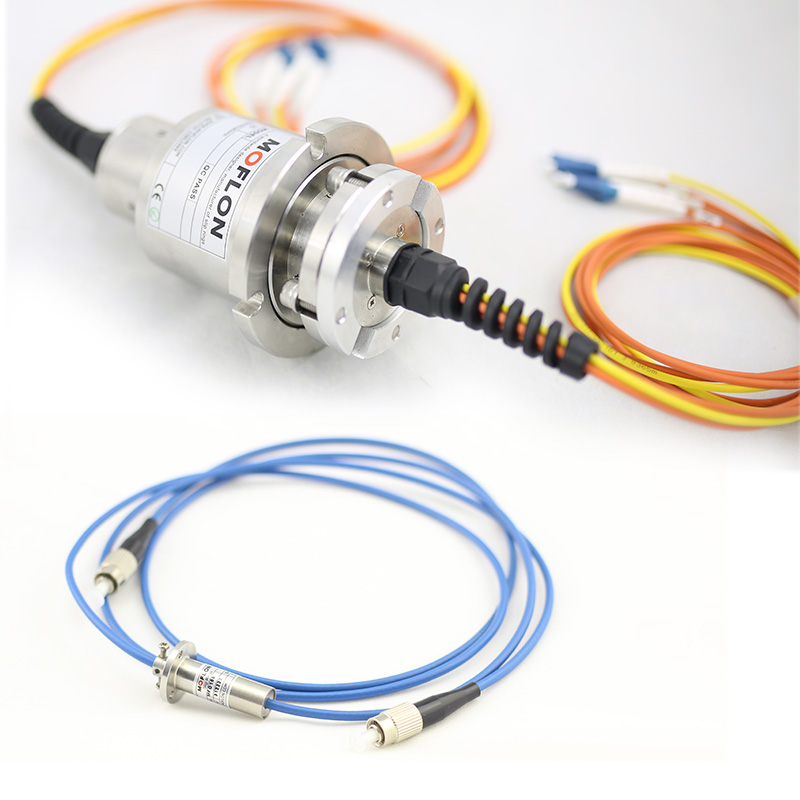
Electrical slip rings have long served as a reliable method for transmitting power and signals across rotating interfaces. However, their performance degrades sharply when tasked with high-speed data. The root cause lies in the physical contact between brushes and rings. This mechanical interface introduces discontinuities, leading to signal reflections, attenuation, and intermittent connections. As data rates climb into the gigabit range, these imperfections become critical. Even microscopic wear debris or oxidation can disrupt impedance continuity, causing bit errors that render the link unreliable.
Beyond simple contact physics, the bandwidth limitations of slip ring assemblies pose a serious bottleneck. The ring and brush structure forms an unintended capacitive and inductive network that attenuates high-frequency components. This filtering effect distorts fast-rising digital signals, closing the eye diagram and increasing jitter. While some designs incorporate coaxial channels or impedance-matched paths, the rotating mechanical nature inherently restricts the achievable bandwidth. What works for a few megabits per second often fails completely when pushing hundreds of megabits through the same physical path.
Maintenance and environmental factors further erode the viability of slip rings in data-heavy applications. Friction produces debris that contaminates contacts, while humidity and temperature swings accelerate corrosion. Each of these variables compounds signal degradation unpredictably, turning what might work in a lab into a field nightmare. Engineers frequently find themselves chasing intermittent faults that vanish after cleaning, only to reappear. In modern systems where reliable, continuous high-speed data flow is non-negotiable, such behavior forces a shift toward contactless alternatives like fiber optic rotary joints or capacitive couplers.
Optical Precision: Eliminating Signal Degradation in Rotating Interfaces
Maintaining signal integrity across rotating interfaces has long been a challenge in high-speed data and communication systems. Traditional slip rings rely on physical contact, which inevitably leads to wear, noise, and intermittent connections that corrupt the signal over time. Optical rotary joints offer an elegant alternative by using light to bridge the rotating gap, completely bypassing the mechanical limitations of metal-based contacts. Because photons don't degrade like electrons in a sliding interface, the signal remains pristine regardless of rotation speed or duration.
The precision of optical alignment is what sets these interfaces apart. A well-designed fiber optic rotary joint employs micro-optics and precision bearings to maintain collimation and minimize insertion loss, even under harsh conditions. The beam path is engineered to withstand vibration, temperature shifts, and continuous motion—factors that would cripple an electrical contact. Whether it's transferring multi-gigabit data streams or delicate analog signals, optical coupling ensures that what goes in is exactly what comes out, with no added jitter or bit errors.
In practice, this translates to a dramatic improvement in system reliability and performance. Medical imaging devices, radar pedestals, and industrial automation platforms all benefit from the elimination of signal degradation. Without the need for routine cleaning or replacement of worn contacts, downtime shrinks and data fidelity rises. Optical precision doesn't just solve the problem of rotating signal transmission—it redefines the standard, making previously unattainable data rates and resolutions a practical reality.
Real-World Applications Where Signal Integrity is Non-Negotiable
In high-speed data centers, signal integrity determines whether terabits of information reach their destinations without corruption. A single reflection or crosstalk event can flip bits and cascade into system-wide outages. Engineers painstakingly model every via, connector, and trace to ensure that eye diagrams remain wide open, because even a picosecond of jitter can violate tight timing budgets.
Medical imaging systems rely on pristine signals to render accurate diagnostics. In an MRI machine, the faint radio-frequency echoes from patient anatomy must travel through cables and interconnects without distortion; any noise introduced by a poorly terminated transmission line could masquerade as a lesion, undermining clinical confidence. Here, signal integrity is literally a matter of life and death.
Automotive radar and LiDAR modules demand flawless pulse fidelity for object detection at highway speeds. A degraded return signal might cause a vehicle to misinterpret a guardrail as open road, or a pedestrian as a stationary pole. As autonomous driving evolves, the tolerance for signal degradation shrinks to zero—making robust board-level and channel-level integrity a foundational requirement, not an afterthought.
Design Innovations That Maximize Optical Slip Ring Performance
Traditional optical slip rings often face performance ceilings due to alignment tolerances and signal degradation across rotating interfaces. Recent design breakthroughs are rethinking the very architecture, moving beyond simple fiber-to-fiber coupling. By integrating micro-optical elements directly into the rotor-stator assembly, engineers have created near-lossless beam paths that maintain integrity even under high-speed rotation. These compact arrangements eliminate the need for bulky collimators, significantly reducing insertion loss and back-reflection while allowing more channels in the same form factor.
One of the most impactful innovations lies in the use of gradient-index lenses and angled physical contact techniques. Rather than relying on free-space optics alone, these methods shape and steer the light with precision that rivals fiber connections. The rotor no longer merely passes light; it actively conditions the signal to counteract mechanical shifts. Advanced materials like low-expansion ceramics and diamond-like carbon coatings on bearing surfaces further stabilize the optical path, ensuring that thermal drift or vibration no longer compromises performance. This holistic design approach turns potential failure points into sources of robustness.
The result is a new generation of optical slip rings capable of carrying hundreds of gigabit-per-second data streams with jitter measured in femtoseconds. Beyond data, they reliably transmit high-power laser beams for industrial sensing and medical imaging, all while rotating indefinitely at tens of thousands of RPM. These systems require minimal maintenance because their non-contact optical interfaces never wear, and built-in self-cleaning mechanisms keep critical surfaces particle-free. The marriage of precision mechanics and photonics is not just extending lifetimes—it is fundamentally changing what rotating platforms can achieve in aerospace, robotics, and deep-sea exploration.
The Future of Rotating Data Transfer: Beyond Traditional Contacts
Traditional slip rings and rotary joints have long been the backbone of rotating data transfer, but their physical contact limits speed, reliability, and lifespan. As industries push for higher bandwidths and maintenance-free operation, the shift toward contactless technologies like capacitive, inductive, and optical couplings is accelerating. These methods offer wear-free transmission, enabling continuous rotation without degradation, making them ideal for robotics, wind turbines, and medical imaging systems where downtime is unacceptable.
Optical rotary joints, for instance, use fiber optics to pass vast amounts of information across rotating interfaces, supporting gigabit-per-second data rates critical for high-resolution video and real-time control. Meanwhile, near-field wireless power and data systems are blending energy and signal transfer into a single compact unit, removing the need for separate cabling. This integration paves the way for smarter, lighter rotating assemblies that can self-diagnose and adapt to changing loads, reducing total system complexity.
Looking ahead, the convergence of materials science and signal processing will likely give rise to hybrid rotary interfaces that seamlessly combine multiple transmission modes. These systems will not only transfer power and data but also feed sensor information back into control loops for predictive maintenance. The future isn’t just about removing physical brushes or rings—it’s about turning the rotary joint into an intelligent node within the broader Industrial Internet of Things, where every rotation brings actionable insights.
FAQ
A substantial optical slip ring is a rotary joint designed to transmit optical signals across a rotating interface without physical contact. It ensures continuous data flow between stationary and rotating parts in systems where traditional wiring would fail due to twisting. By using optical pathways, it supports high-bandwidth communication and precise control signals, which are critical in applications like wind turbines, robotic arms, and medical imaging equipment where uninterrupted rotation is required.
Traditional electrical slip rings rely on physical brush contacts that can introduce noise, wear, and signal degradation over time. In contrast, a substantial optical slip ring uses free-space optics or fiber-based coupling to transmit light signals. This eliminates electrical contact resistance, electromagnetic interference, and crosstalk, preserving signal integrity even at high rotational speeds. The result is cleaner, more reliable data transmission with minimal bit errors.
Effective high-speed data transmission relies on precision-aligned optical components such as gradient-index lenses, collimators, and fiber optic interfaces. The design often incorporates multiple optical channels to handle parallel data streams, and the housing is engineered to maintain strict alignment under vibration and thermal expansion. Additionally, the use of single-mode or multimode fibers with appropriate connectors ensures low insertion loss and high return loss, crucial for maintaining signal quality over long uninterrupted operation.
These devices are commonly used in fields that demand high-reliability data transfer while rotating, such as aerospace and defense for radar systems, offshore wind turbines for pitch control, medical CT scanners for gantry rotation, and marine winches for subsea communications. They are also found in factory automation, where robotic joints need to pass high-resolution video and sensor data without latency.
Optical transmission is inherently immune to electromagnetic interference (EMI) because it relies on photons rather than electrons. This means that signals do not couple with external magnetic fields generated by motors or other equipment. Moreover, the absence of physical contacts eliminates arc-induced noise and wear debris, which are common sources of signal distortion in mechanical slip rings. The result is a pristine signal path that remains unaffected by the harsh electrical environment typical of industrial rotating machinery.
These slip rings can transmit a wide range of optical signals, including digital data protocols like Ethernet, serial communication links, and analog optical signals for video or sensor feeds. For Ethernet, the benefit is high throughput with low latency, ideal for real-time control. For analog signals, optical transmission provides excellent linearity and no grounding issues. They can also pass optical power in some designs, enabling remote sensing without electrical power at the rotating end.
Yes, customization is common. Design parameters such as the number of optical channels, the type of fibers, the housing materials, and sealing can be tailored. For high-speed applications, balanced rotating components and high-precision bearings are used. For harsh environments, the slip ring can be hermetically sealed and built with corrosion-resistant materials to withstand salt spray, extreme temperatures, or explosive atmospheres, ensuring consistent performance regardless of the operational demands.
Because there are no contacting parts in the optical path, there is no mechanical wear, which extends service life significantly. Maintenance intervals are longer, and the risk of unexpected downtime due to contact degradation is nearly eliminated. Optical slip rings also do not require regular brush replacement or cleaning of commutator surfaces. Over the life of the equipment, this translates into lower total cost of ownership and higher overall system availability.
Conclusion
Optical slip rings represent a fundamental leap in rotating data transmission, tackling the persistent challenge of maintaining signal integrity where physical contacts fail. Unlike electrical slip rings that suffer from brush wear, electrical noise, and bandwidth limitations as speeds climb, these systems channel light through precisely aligned fibers or free-space optics. The core mechanism relies on non-contact photon transfer, effectively decoupling rotation from data flow. This eliminates micro-interruptions and impedance mismatches that plague traditional rings, enabling jitter-free, high-bandwidth communication even under extreme rotational velocities. The result is a transmission medium inherently immune to EMI, crosstalk, and the gradual erosion of conductive paths, ensuring that the original signal—whether it's gigabit Ethernet or high-definition video—arrives at the receiver with its timing, amplitude, and spectral content fully preserved.
In environments where signal degradation is simply not an option—think medical CT scanners reconstructing sub-millimeter slices, wind turbines relaying blade-pitch data amid lightning storms, or military radars tracking multiple targets—optical slip rings have become indispensable. Recent design innovations, such as multi-channel wavelength multiplexing and advanced GRIN lens collimators, push channel density and alignment tolerance further, enabling compact systems that can carry dozens of high-speed lanes simultaneously. Looking ahead, the integration of photonic integrated circuits and adaptive optics hints at slip rings that self-optimize in real time, compensating for thermal drift or vibration without human intervention. By shifting the paradigm from mechanical contact to pure optical coupling, these devices not only conquer today’s signal-integrity bottlenecks but also lay the groundwork for tomorrow’s autonomous platforms, where reliable, low-latency data exchange across rotating joints is critical to system intelligence and safety.
Contact Us
Contact Person: Xiangpin Li
Email: [email protected]
Tel/WhatsApp: 86 186 1706 8578
Website: https://www.moflon.com