

OEM 132kV Galvanized Angle Steel Transmission Tower Factory Builds Durable High-Voltage Power Infrastructure
2026-11-16
High-voltage transmission lines are only as reliable as the structures that carry them. When a 132kV galvanized angle steel tower leaves the factory, it must withstand decades of wind, corrosion, and electrical stress without compromise. This is where Anbang steps in — not just as a manufacturer, but as an engineering partner obsessed with the details that keep power flowing through the grid. In the following post, we look at how OEM production of these towers turns raw steel into the backbone of durable high-voltage infrastructure, and why utility planners are paying closer attention to what happens before the first bolt is tightened.
What a 132kV Angle Steel Tower Needs Before It Leaves the Factory
Before a 132kV angle steel tower gets cleared for dispatch, it usually spends its final hours in the yard undergoing a trial assembly. This is not a quick visual once-over. The crew picks a complete bay or a full leg section, bolts it together with the exact hardware that will ship, and checks that every splice plate seats without forcing. If a gusset needs a hammer, the hole pattern gets marked for reaming before the whole bundle is broken down and packed.
The galvanizing line leaves its own fingerprints, and someone has to read them. Zinc thickness gets checked with a probe on the flanges and edges, not just on a flat coupon. Areas around the bolt holes are inspected for drips, runs, or ash that would keep a nut from seating properly later. Small repairs to the coating are done with zinc-rich compound, but only within the permitted area; anything larger goes back for regalvanizing.
Paperwork and marks matter as much as steel. Each bundle carries a match mark that ties it back to the erection drawing, and the mill certificates stay with the heat numbers stamped on the members. Any torque marks on the trial-assembled bolts get wiped or replaced before packing. Once the checklists are signed by both the quality inspector and the production supervisor, the tower is released for loading, with the bolt count and packing list verified against the dispatch note.
The Galvanizing Step That Keeps High-Voltage Structures Standing Longer
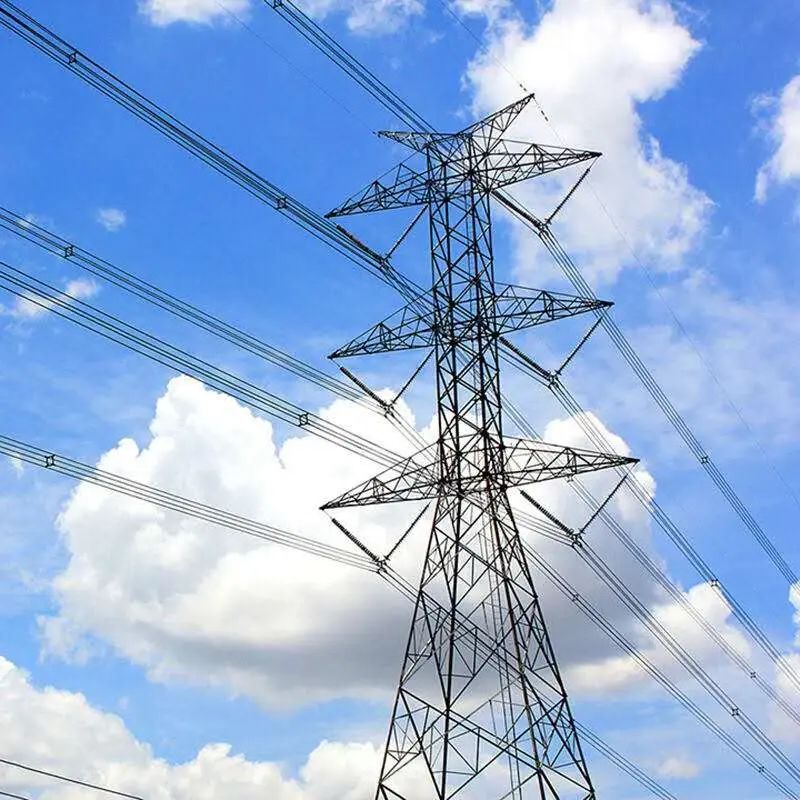
Hot-dip galvanizing is not a coating in the ordinary sense. When steel lattice members enter the molten zinc bath, the zinc reacts with the iron to build a series of intermetallic layers that become part of the steel itself. Those layers are hard, tightly bonded, and far less likely to peel or chip than a sprayed film, which is exactly what a high-voltage structure needs when rigging, climbing spikes, and tools scrape against it over the years.
The outer zinc skin also works as a sacrificial layer. If a scratch reaches bare steel, the surrounding zinc corrodes first and produces a stable, protective patina over the damaged spot. In coastal salt air, acid rain, or rural frost, that self-healing behavior keeps small nicks from turning into structural rust. For utilities, it means fewer line crews hanging off a tower with touch-up paint and more years of uninterrupted service.
Not every galvanized finish ages the same way, though. Steel chemistry, immersion time, and bath temperature all influence the coating's thickness and its final mottled gray appearance. When those variables drift, even two towers from the same drawing can weather differently. Getting the galvanizing step right is therefore less about covering the steel and more about creating a surface that can take decades of weather without quietly giving up at the bolts and joints.
OEM Tower Design Without the Usual Back-and-Forth
Most tower design cycles get stuck in a loop of emailed drawings, marked-up PDFs, and waiting on answers that should have been clear from the start. We compress that loop by bringing thermal, structural, and cable-routing decisions into a single working session. You get a dimensional layout, mounting details, and a draft bill of materials before the first formal review, not after three rounds of clarification.
The difference comes from how requirements are captured. Instead of asking for a general spec sheet, our engineers map the actual board keep-outs, airflow direction, connector positions, and service access needs directly onto a shared 3D model. Changes are made live, with everyone looking at the same revision. That removes the ping-pong of "can you move this 5 mm" emails and replaces it with a working document that already reflects what manufacturing needs.
The result is a tower enclosure that fits the electronics, the thermal budget, and the assembly floor without a long discovery phase. Clients typically sign off on a prototype-ready design after one short review call, because the details that normally cause back-and-forth were resolved while the model was still on screen.
Why Terrain Shapes Tower Specs More Than a Template Does
A template assumes the ground is flat, the soil is predictable, and the wind behaves the same from every compass point. Real sites rarely cooperate. A ridge line that funnels katabatic winds at twice the design speed, a slope that shifts under its own weight after heavy rain, or a rocky ledge that refuses standard anchor depths—each forces a rethink that no off-the-shelf drawing can anticipate. The template is a starting sketch; the terrain is the final referee.
When surveyors walk a route, they read more than contours. A tower placed on a shoulder might need an extra two meters of leg extension to keep antenna clearances above a convex slope. A valley floor with seasonally high groundwater changes the foundation from a simple pad to a deep pier with uplift anchors. Even the direction of a prevailing storm track matters: a tower tucked behind a bluff can often use lighter bracing than an identical structure exposed on a spur. These adjustments are not minor tweaks—they alter steel tonnage, concrete volume, and sometimes the entire erection method.
The best designers treat a terrain survey as a conversation with the land. They note where access roads will bog in spring, where a crane can actually stand without benching, and where rock anchors will hold better than buried deadmen. Once those site-specific answers are in hand, the tower stops being a generic product and becomes a response to a particular place. That is why a field observation of a 15-degree cross slope often carries more weight than a hundred pages of standardized details.
How Durable Tower Frames Handle Wind, Ice and Grid Demands
Wind seldom hits a tower as a steady push. It arrives in gusts, changes direction across the face of the structure, and can set slender members vibrating near their natural frequency. A frame that holds up over time does more than use thicker steel: the diagonal pattern, bolt spacing, and leg taper are arranged so that gust energy moves through the frame without concentrating at a single weak point. On exposed ridges, you will often see tighter bracing and shorter unsupported lengths, which raise the structure's stiffness without adding unnecessary mass.
Ice builds unevenly. One side of a crossarm may carry a heavy glaze while the leeward side stays nearly bare, and when a span sheds ice suddenly the tower has to absorb a sharp unbalanced load. Durable frames account for this by treating ice not as a simple vertical weight but as a load that changes the shape of the tower's deflection. Drain holes, sealed lap joints, and galvanized surfaces keep moisture from working into connections where freezing and thawing would slowly pry members apart.
Grid demands add another layer: short-circuit forces can jerk conductors hard enough to test every joint, while everyday thermal changes keep steel expanding and contracting under tension. Frames built for this environment rely on slip-resistant bolted connections and fatigue-conscious detailing rather than just higher yield strength. The result is a structure that handles repeated small movements without loosening, and still stays stable when the wind, ice, and electrical loads arrive at the same time.
From Raw Angle Steel to a Transmission Tower Ready for Service
Angle steel arrives at the fabrication yard in long, dark lengths, still carrying mill scale and the faint marks of its heat number. Before anything else happens, each piece is checked against the material certificates and measured for straightness, thickness, and edge condition. Bundles are then moved to a cutting station, where saws and shears break them down into the exact leg lengths, diagonals, and gusset plates called for in the shop drawings. The tolerances are tight because a tower is not a forgiving structure; a few millimeters of drift at the base can become a visible lean at the top.
Once cut and punched or drilled, the steel passes through galvanizing. The pieces are hung on racks, dipped into molten zinc, and pulled out with that familiar mottled silver finish. After cooling, inspectors check coating thickness and look for bare spots, runs, or sharp edges that would invite early corrosion. From there the parts are bundled by tower section and shipped to the site, where crews assemble them on the ground in panels before lifting them into place. Bolts are torqued in a specific sequence, and each completed section is checked for plumb and alignment before the next one goes up.
By the time the last crossarm is secured and the ground wire is pulled into position, the raw angle steel has become part of a load path that stretches from foundation to conductor. Final checks cover bolt tension, missing members, and grounding connections. Only after those pass does the tower move from a collection of galvanized parts to a piece of infrastructure that can be handed over for service.
FAQ
It focuses on 132kV lattice towers built from galvanized angle steel, the kind used to carry transmission lines across long distances. The workshop handles cutting, drilling, bending, and trial assembly so the final structure fits together without surprises on site.
Angle steel gives a strong load-bearing frame while keeping the tower lighter and easier to transport. The hot-dip galvanizing adds a zinc layer that holds up against rain, humidity, and industrial pollution, which means fewer rust-related repairs over the life of the line.
It means the factory works from your drawings or performance requirements rather than forcing a stock design. That can include adjusting leg sizes, bolt patterns, crossarm positions, and foundation details to match local wind zones, terrain, and line tension.
Each batch goes through dimensional checks, weld inspection, and zinc-coating thickness tests. Many projects also require a trial assembly of the first tower, which catches fit-up issues before mass production and shipping.
Yes, the same production line is generally set up for lattice towers in the 33kV to 220kV range or higher, depending on the design data. 132kV is a common backbone voltage, but the engineering team can adapt the geometry for other voltage classes if the loading calculations support it.
A basic request should include line voltage, conductor type, span length, wind speed, terrain category, and tower type such as suspension or tension. If you already have structural drawings, that speeds things up; if not, the factory can propose a reference design for review.
They are normally bundled by tower section and marked with part numbers so the crew can unload and sort them quickly. For export orders, the factory can use steel pallets or containers, and it adjusts the packing list to match your preferred shipping method and site access.
The core product is the fabricated steel tower, but the engineering team can provide erection drawings, bolt schedules, and foundation reaction data. On request, supervisors can travel to the site to guide the first assembly and make sure the galvanized members are handled correctly.
Conclusion
A 132kV angle steel transmission tower leaves the factory only after a sequence of checks that goes well beyond basic assembly. Raw angle steel is cut, punched and welded, then each section is measured against the approved drawings before any coating is applied. Holes and joint clearances are verified because even minor misalignment can weaken the structure once it is under line tension. The hot-dip galvanizing step matters just as much as the steel grade. When the cleaned sections enter the zinc bath, the coating bonds to the surface and forms a protective layer that keeps corrosion out of the high-voltage structure for decades, especially in industrial or coastal air. That combination of dimensional control and galvanizing is what allows the frame to remain stable long after it reaches the site.
OEM work changes the usual design process because the factory team starts from line loads, span lengths, conductor weight and local climate instead of forcing a standard drawing onto the project. Wind speed, ice thickness and soil conditions shape member sizes, bracing patterns and foundation loads more than any ready-made template ever could. Terrain and altitude push the design toward stronger legs, tighter bolt spacing or adjusted cross-arm lengths, while the overall geometry still fits a 132kV system. After fabrication and coating, trial assembly confirms that every joint fits before shipping. From raw angle steel to a fully galvanized frame that handles wind, ice and changing grid demands, each stage is tied to making the transmission line dependable rather than simply delivering steel.
Contact Us
Contact Person: antor khan
Email: [email protected]
Tel/WhatsApp: 8613863903569
Website: https://www.qdabtower.com/