

High Titanium White Masterbatch: Top Choices for Superior Brightness and Opacity
2026-08-24
When it comes to achieving that crisp, clean white in plastics, not all masterbatches are created equal. High titanium white masterbatch is the industry's go-to for unmatched brightness and hiding power—but finding a supplier that consistently delivers quality can be a challenge. That's where Xinwancai steps in, offering top-tier formulations designed to take your products from dull to dazzling.
High Titanium White Masterbatch in Thin Films: Where Hiding Power Matters Most
In thin film applications, achieving true opacity is a constant battle against translucency. Ordinary white masterbatches often fall short, delivering a washed-out appearance or requiring excessive loading that compromises film strength. High titanium white masterbatch changes this dynamic by packing exceptional hiding power into every gram, allowing converters to hit target L* values at lower addition rates. The result is a film that blocks light effectively without sacrificing tensile properties or seal integrity—critical for packaging where product visibility must be controlled.
The real advantage surfaces in demanding substrates like cast stretch film, blown film for agricultural mulch, or multi-layer barrier structures. Here, film thickness can drop below 20 microns, yet the need for uniform opacity remains uncompromising. A precisely engineered titanium dioxide dispersion—often surface-treated for optimal wetting and reduced agglomeration—ensures that each pigment particle contributes fully to light scattering. This means fewer pinholes, less streakiness, and a consistent matte or bright white finish that holds up under stretching, folding, and outdoor exposure.
Beyond mere aesthetics, hiding power in thin films translates into functional benefits. It shields light-sensitive contents from degradation, prevents show-through of underlying printed layers, and reduces the need for additional tinting or lamination. Producers who specify high-performance white masterbatch are not just buying opacity; they are buying process stability and end-product reliability. In markets where a flawless white surface signals quality—from diaper backsheets to label stock—the right masterbatch turns a marginal film into a premium one.
Balancing Titanium Dioxide Loading and Melt Flow in Polyolefin Systems
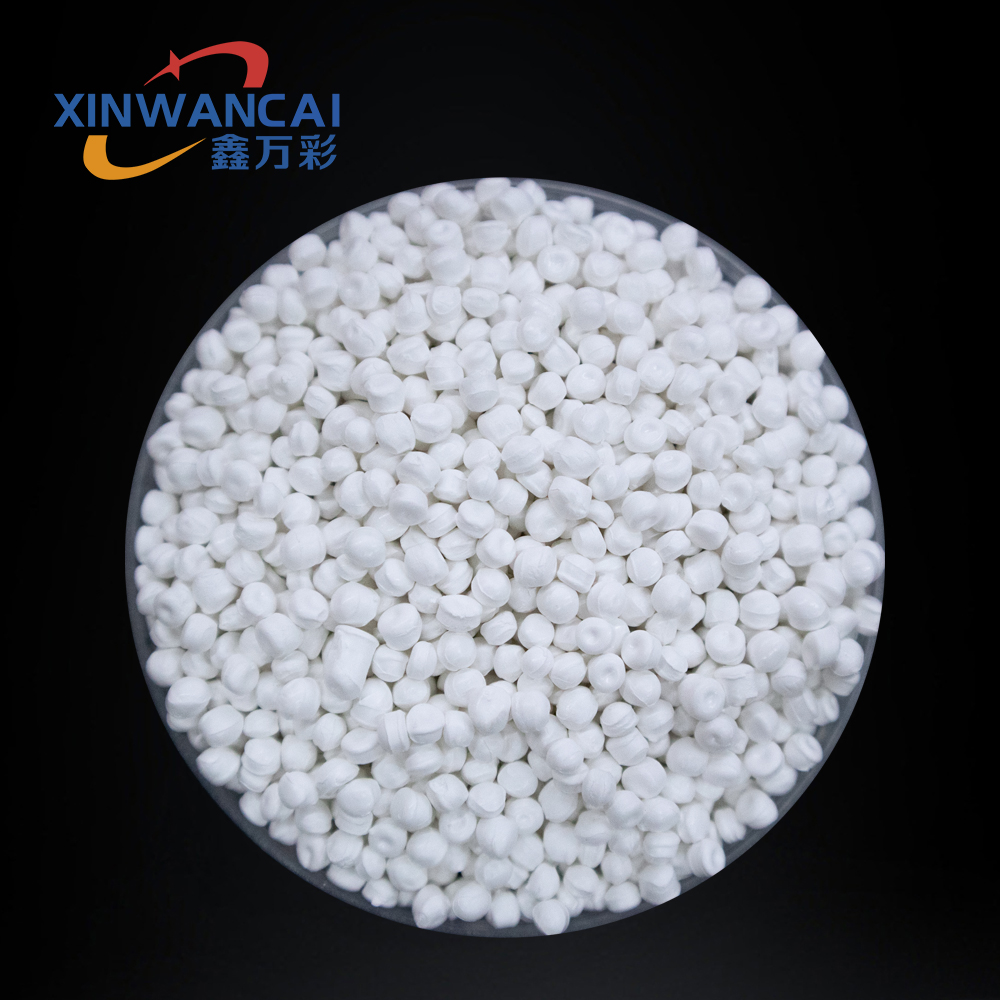
Achieving an optimal balance between titanium dioxide loading and melt flow in polyolefin formulations requires more than simply increasing pigment concentration. As TiO2 levels rise, the polymer compound typically becomes more viscous, lowering its melt flow index and making extrusion or injection molding more energy-intensive. This trade-off is especially pronounced in high-opacity films and thin-walled parts, where processing windows narrow and surface defects become more likely.
One practical approach is to start with a base polyolefin that already has a higher melt flow rate, then compensate for the viscosity increase caused by the pigment. Combining this with a well-dispersed TiO2 masterbatch rather than neat powder helps reduce agglomeration and uneven flow. In some cases, lightly treated pigments or small amounts of internal lubricants can also restore processability without sacrificing opacity or UV protection.
Rheological testing remains the most reliable way to fine-tune the balance. Tracking melt flow index, capillary viscosity, and dispersion quality across a range of loadings allows formulators to identify the highest workable TiO2 concentration for a given machine setup. The goal is not to maximize pigment content, but to find the point where end-use performance and stable, repeatable processing intersect.
Dispersion and Plate-Out: Practical Limits of High-White Concentrates
High-white concentrates push titanium dioxide loadings to levels where the pigment particles no longer behave as isolated individuals. At 70–80% TiO2 by weight, the distance between particles shrinks dramatically, and interparticle forces start dominating over the wetting action of the carrier resin. The result is that even with a well-matched dispersant, small clusters survive mixing and create micro-roughness in finished films or molded parts. These clusters also scatter light differently, so the promised high opacity never quite materializes on the production line.
Plate-out is the more visible and annoying cousin of poor dispersion. The same high pigment concentration raises the melt viscosity unevenly, and low-molecular-weight additives—waxes, stearates, or even some processing aids—can migrate to the metal surface of the die or calender roll, carrying fine TiO2 particles with them. Over time, a white, chalky deposit builds up, causing surface defects, die lines, or intermittent specks that force unscheduled downtime. Unlike dispersion problems that might be hidden inside a thick part, plate-out announces itself on every glossy or precision surface.
There is a practical ceiling for high-white concentrates that has less to do with chemistry and more to do with how the material behaves under real shear and temperature gradients. Formulators often find that dropping the TiO2 loading by just 5–10% eliminates most plate-out issues while retaining nearly the same opacity, especially if the carrier resin is chosen for its wetting rather than just its compatibility. In other words, chasing the highest possible white concentrate may save freight costs but can cost far more in scrap, cleaning cycles, and rejected color batches.
Whiteness Retention Under Heat and Weathering: What to Look For in a Grade
A pigment's whiteness retention under heat and weathering is not just about starting brightness. Heat can accelerate oxidation of the polymer matrix or cause crystal lattice defects to surface, while UV exposure and moisture cycles often lead to yellowing or chalking. When comparing grades, ask for data that goes beyond initial L* or CIE whiteness. The key is how much whiteness is lost after a defined thermal aging cycle and after controlled QUV or xenon-arc exposure. Grades that hold their whiteness typically show a smaller shift in Delta E and a lower yellowing index (Delta b) over the same test period, not just a higher starting number.
Surface treatment plays a larger role than many formulators expect. A denser silica or alumina coating can shield the pigment surface from photocatalytic activity, but too heavy a treatment may reduce dispersion or slightly mute initial brightness. Look for grades where the coating is optimized for both weathering and thermal stability—some suppliers report whiteness retention after 500, 1000, and 2000 hours of accelerated weathering, and the difference between a truly durable grade and an average one often appears only after 1000 hours. Also compare the type of test: a QUV-B lamp is far more aggressive than QUV-A, and a high temperature cycle (e.g., 150°C or above) will reveal organic surface treatments that break down and cause yellowing later.
In practice, request weathering data from the same resin system or at least a similar one to your application, because polymer degradation products can interact with the pigment and shift yellowness. Check the temperature range used in heat aging; a grade that survives 120°C may fail at 180°C if the coating decomposes. Also pay attention to chalking ratings and gloss retention after weathering, since a loss of surface integrity will eventually make even the whitest pigment look dull. The best grades are not necessarily the brightest on day one—they are the ones that keep the closest to their original whiteness after heat and weather cycles that match your use conditions.
Comparing Opacity Costs Across Polyethylene, Polypropylene, and Polystyrene
When you dig into the real numbers behind opacity, the story gets messier than most datasheets suggest. Polyethylene, especially in its low-density form, tends to require higher loadings of opacifying additives like titanium dioxide to hit the same visual barrier as polypropylene. That added percentage point or two might seem trivial until it multiplies across a year of production, pushing both raw material cost and compounding energy upward. Polypropylene sits in a comfortable middle ground—its semi-crystalline structure scatters light more efficiently, letting manufacturers trim pigment levels without sacrificing the milky, non-translucent finish that many food and personal care packages demand.
Polystyrene, on the other hand, flips the calculation. General-purpose polystyrene starts out naturally clear, so the cost of making it opaque isn't about fighting intrinsic haze—it's about completely reversing the optical path. Because the polymer matrix already transmits light so well, even small amounts of white pigment create a stark, glossy opacity that polyethylene can only mimic with heavier doses. But that advantage comes with a trade-off: polystyrene's brittleness often pushes converters toward impact-modifier blends, and those modifiers can eat into the per-unit savings you gained on pigment. The result is a shifting break-even point that depends heavily on part geometry, wall thickness, and whether the opacity requirement is absolute or just “good enough” for shelf visibility.
A practical way to frame this is cost per square meter of opaque surface, not cost per kilogram of resin. Run that math on a thin-wall cup or a blow-molded bottle, and polyethylene's additive-heavy recipe often loses ground to polypropylene's leaner pigment load. Switch to a thick-walled cosmetic jar, and polystyrene's intrinsic clarity becomes irrelevant because you need so much pigment to block light through the extra material depth. Smart sourcing teams treat opacity as a system cost—resin + pigment + processing energy + scrap rate—rather than a standalone line item. Otherwise, a resin that looks cheap on the purchase order quietly becomes the most expensive option once the opacifier invoices start stacking up.
Fine-Tuning Letdown Ratios for Stable Brightness in Injection Molding and Film
Adjusting letdown ratios is often treated as a simple math problem, but in practice it becomes a balancing act between pigment loading, resin compatibility, and process temperatures. Small shifts in the carrier resin can alter dispersion quality, which directly affects how uniformly light scatters through the part or film. Rather than relying on a fixed percentage from a datasheet, molders and extrusion operators need to test ratios under actual production speeds and cooling rates, because a ratio that works in a lab sample may produce visible streaks or dull spots on the line.
For injection molding, the letdown ratio influences not just brightness but also surface gloss and weld line visibility. A common mistake is increasing pigment concentration to compensate for thin walls, only to create uneven color density where flow fronts meet. Instead, working with a finer particle size pigment or a higher melt flow carrier can maintain the same letdown percentage while improving brightness consistency. Monitoring shot-to-shot variance under different back pressures and injection speeds helps identify whether brightness shifts come from the ratio itself or from shear-induced pigment degradation.
In blown or cast film, stable brightness depends more on gauge uniformity and chill roll temperature than on pigment alone. A higher letdown ratio may initially boost opacity, but if the film draws unevenly, thin areas appear brighter and thick areas look dull regardless of pigment loading. Running a designed experiment with three letdown levels while recording haze, gloss, and luminance at multiple points across the web often reveals that the optimal ratio for visual brightness is lower than what a colorimeter reading suggests, because the human eye is more sensitive to local variations than to average values.
FAQ
A high titanium white masterbatch carries a much heavier load of titanium dioxide, often 50% to 80% by weight, compared with standard grades that may use fillers or lower pigment concentrations. This higher loading translates into stronger hiding power and a cleaner, brighter white without forcing you to push the letdown ratio to extreme levels.
Titanium dioxide has one of the highest refractive indices among white pigments, so it bends and scatters light very effectively. When enough TiO2 is present and well dispersed, the plastic surface reflects more light instead of letting it pass through to reveal the base resin or regrind underneath. That is what gives the final part its visual brightness and solid, non-translucent appearance.
Thin-gauge films, injection-molded containers, sheets, pipes, and nonwoven fabrics tend to gain the most. These products often need high opacity at a low wall thickness or basis weight, so a concentrated white masterbatch lets you hit the target without sacrificing mechanical properties or processing stability.
Check the actual TiO2 percentage, the carrier resin type, melt flow compatibility with your base polymer, dispersion quality, and thermal stability under your processing temperatures. Also look at lot-to-lot consistency and whether the grade meets any regulatory requirements relevant to your end market.
Because you need less masterbatch to reach the same opacity, you can lower the total additive dosage. That reduces freight, storage, and metering costs, and it also minimizes the dilution of the base resin. In many cases the higher upfront price per kilogram is more than offset by the lower usage rate and fewer rejected parts.
Yes, but only if the specific grade is formulated and approved for food-contact applications. Many suppliers offer variants with compliant carriers and additives that meet FDA, EU, or other regional food-contact requirements. Always request the relevant compliance documentation instead of assuming any white masterbatch is suitable.
Poor dispersion, screw slippage, and inconsistent tint strength are the most frequent issues. They usually come from using an incompatible carrier, feeding too fast, or running at temperatures that degrade the additives. Choosing a masterbatch with the right carrier resin, maintaining steady feed rates, and allowing adequate mixing in the screw can prevent most of these problems.
A practical approach is to produce a film or plaque at a controlled thickness and measure the contrast ratio or L* value with a spectrophotometer. Visual checks against a standard white tile can work for quick comparisons, but instrumental readings give you repeatable data for lot acceptance and supplier benchmarking.
Conclusion
Selecting a high titanium white masterbatch isn't simply about chasing the highest TiO2 percentage. In thin polyethylene and polypropylene films, opacity per micron depends on how well the pigment is dispersed, not just how much is crammed into the carrier. Overloading titanium dioxide quickly raises viscosity, destabilizes bubble geometry in blown film, and leads to plate-out on die lips. The better grades use surface-treated rutile and tightly controlled carrier resins so that hiding power holds without sacrificing melt flow. This matters most in downgauged films where a 10-micron layer still must block light and hide contents.
Whiteness retention under heat and weathering separates commodity concentrates from engineering choices. Polyolefin grades exposed to oven aging or outdoor UV need stabilizer packages that prevent yellowing without dulling initial L* values. Cost comparisons across PE, PP, and PS rarely favor the cheapest masterbatch; polystyrene often requires lower loadings for equivalent hiding, while polypropylene can demand higher letdowns to offset its natural translucency. In injection molding and cast film, fine-tuning letdown ratios — sometimes as low as 2% for dense parts, up to 8% for thin film — keeps brightness consistent without overpaying. The smartest selection criteria combine dispersion stability, thermal resistance, and true cost per square meter of covered surface, not just price per kilogram.
Contact Us
Contact Person: JACK
Email: [email protected]
Tel/WhatsApp: 86 18650130917
Website: https://www.xinwancai.com/