

China Pyrolysis Equipment Turns Waste into Profitable Fuel
2026-09-20
Every year, mountains of waste pile up while fuel costs keep climbing. What if that trash could become a revenue stream instead of a problem? China’s pyrolysis equipment is doing exactly that—converting plastics, tires, and industrial sludge into sellable fuel oil, carbon black, and gas. For plant operators and investors, this isn’t just recycling; it’s a practical way to cut disposal fees and open new profit channels. Tundrr has been tracking how modular designs and smarter controls now make these systems easier to run than ever before, even for mid-sized facilities. In this post, we’ll break down the real economics, the types of feedstock that pay off fastest, and what to watch for before you buy.
Why Chinese Pyrolysis Plants Are Quietly Rewriting the Rules of Waste
Walk through any industrial park in Shandong or Henan and you might miss them at first—unassuming steel reactors, modest control rooms, and stacks of baled waste tires that never make the evening news. Yet these facilities are turning a global waste problem into a quiet, profitable supply chain. Chinese pyrolysis plants have moved far beyond the crude, smoke-belching operations of a decade ago. Today they run on continuous feed systems, recover heat with thermal oxidizers, and produce pyrolysis oil that rivals virgin naphtha in certain petrochemical streams. What changed wasn't a single breakthrough, but a relentless cycle of trial, failure, and incremental cost-cutting that only China's manufacturing ecosystem could sustain.
The real edge isn't in the chemistry—it's in how these plants are built and run. A standard 10-ton-per-day unit can be assembled in under six weeks using domestically produced reactors, condensers, and emissions scrubbers that cost a fraction of Western equivalents. Operators swap out worn parts without waiting on imported spares, and they adjust feedstocks daily based on spot prices for waste plastic, rubber, or oil sludge. This flexibility means a plant in Jiangsu might process mixed agricultural film one week and shredded conveyor belts the next, all while staying within tightening emissions rules. No European or North American operator would dare run such a varied diet, but Chinese teams treat it as normal—and that adaptability lets them undercut competitors on both procurement and output pricing.
Critics point to older plants that still flare excess gas or leak volatile organics, and those problems are real. But the new generation tells a different story. Inland provinces now mandate real-time monitoring of stack emissions, and several manufacturers have started exporting turnkey systems with built-in carbon black refinement and syngas-to-power modules. What's emerging is not a single flagship technology, but a distributed, modular approach that turns waste into a menu of outputs: fuel oil, recovered steel, carbon black for asphalt or ink, and enough electricity to run the plant itself. It's less a revolution than a thousand small improvements stacked together—and that's precisely why Western waste management firms are starting to pay attention, not with praise, but with purchase orders.
From Old Tires to Burnable Oil: Inside a Typical China-Made System
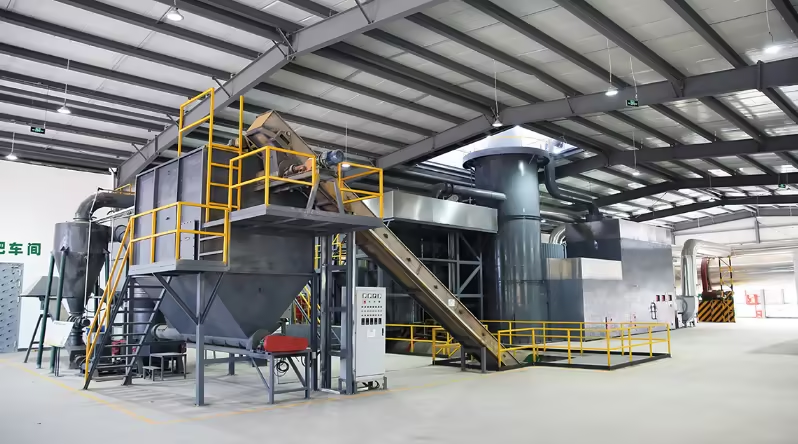
The yard behind the workshop stacks worn tires in uneven rows, their treads cracked and caked with road grit. A loader with a home-welded bucket feeds them one by one into a horizontal steel drum. Inside, the temperature climbs past 400°C without flame touching the rubber directly. What comes out the far end is a dark, thin liquid that smells somewhere between diesel and burnt tar. Workers call it "tyre oil," and it burns readily in modified burners or gets blended for heavier uses.
The system itself is a patchwork of Chinese-made components: a rotary reactor, a set of water-cooled condensers, and a flare stack that handles the gas fraction nobody bothered to compress. Steel wire pulled from the tyre beads drops out of the reactor as scrap, while carbon black gets bagged for sale to local rubber product makers. There is no complex instrumentation, just a few pressure gauges and a manual valve or two. The process runs in batches, each one lasting most of a shift, and shutdowns are common when a seal leaks or a condenser line clogs with waxy residue.
Operators learn by feel: too much heat and the oil turns thick and tarry, too little and the yield drops. A good run yields roughly 40 to 45 percent oil by weight from shredded passenger tyres, though truck tyres with more steel produce less. The end product is not refined fuel; it needs settling, filtering, and often further distillation before it can replace commercial furnace oil. Still, for small factories in industrial parks from Shandong to Guangdong, this kind of plant turns a disposal problem into a steady, if dirty, stream of burnable liquid.
The Real Economics of Converting Plastic Scrap into Fuel
Most discussions about turning plastic scrap into fuel gloss over the messy financial reality. The upfront capital for a pyrolysis or gasification unit is substantial, often reaching tens of millions of dollars for a facility that can handle meaningful volumes. On top of that, feedstock costs are rarely zero: collecting, sorting, and cleaning mixed plastic waste is labor-intensive and logistically expensive, especially when contamination from food residue or non-plastic materials forces extra processing.
Operational expenses quickly eat into any projected margins. These plants require high temperatures and tight process control, which means constant energy input and frequent maintenance. The resulting fuel is typically a low-grade synthetic crude or diesel substitute that needs further refining before it can be sold, and even then it often fetches a lower price than conventional fuels. When oil prices dip, the entire model collapses because the cost of production exceeds the market value of the output.
There are niche cases where the economics work, mainly in regions with high landfill fees, strict waste export bans, or expensive electricity that makes local fuel production attractive. But scaling up remains a challenge: feedstock variability, regulatory hurdles, and the lack of established off-take agreements for the end product keep most projects stuck in pilot stages. The real economics are less about turning trash into treasure and more about finding a narrow window where subsidies, waste management fees, and energy prices align.
What Buyers Often Overlook When Sourcing Pyrolysis Equipment from China
Many buyers lock onto the quoted price and the nominal capacity printed in a brochure, but never ask how that machine actually behaves with their own raw material. Chinese suppliers often base their performance numbers on clean, dry, homogeneous tire chips or plastic flakes, while real-world feedstock arrives wet, dirty, mixed with metal bits or contaminated with PVC. The gap between brochure and reality can easily reduce oil yield and throughput by twenty to thirty percent once the plant is running. Instead of accepting the sales sheet, request a detailed mass balance for your specific feedstock and ask for references who process the same material on a daily basis, not just a generic list of past clients.
A second blind spot is the difference between a genuine manufacturer and a trading company with a nice website. A large share of pyrolysis equipment exported from China comes through intermediaries who buy from small workshops, then slap their own logo on the product. These traders rarely keep spare parts in stock, cannot send an engineer for commissioning, and often disappear when technical problems arise. Before signing anything, ask for the factory's business license, request live video of the production floor with the current date visible, and confirm whether welding, reactor rolling, and control cabinet assembly happen in-house. A real factory will have no problem showing you the shop floor without notice.
Local compliance and long-term maintainability are also frequently ignored. The flue gas treatment, wastewater handling, and char disposal that satisfy Chinese domestic permits may fall short of stricter emission limits in Europe, North America, or Australia, leaving buyers exposed to shutdowns or heavy fines. At the same time, the PLC and electrical components inside the control cabinet may be cheap domestic brands that are hard to source outside China. Check whether the supplier can install internationally recognized components such as Siemens, Schneider, or ABB, or at least confirm that local replacements are readily available before the first breakdown forces a costly and lengthy downtime.
Small Footprint, Steady Output: How Modular Units Handle Mixed Waste
Modular waste handling systems earn their keep in tight spaces. Instead of sprawling conveyors and separate sorting stations, these units combine shredding, screening, and air classification into a single skid-mounted line. Mixed loads—everything from cardboard and film plastic to metal cans—move through without needing manual pre-sorting, which keeps the footprint small while still delivering a steady stream of separated output.
The key is how each module is tuned to work with the next. A slow-speed shredder opens bags and reduces bulky items, then a star screen lifts flexible materials while letting containers fall through. Because the modules are pre-wired and pre-piped, swapping one out or adjusting capacity takes hours, not days. That plug-and-play design lets operators handle variable waste streams without expanding the building or adding extra shifts.
Output stays consistent because the line is sized for the actual volume, not peak spikes. Modular units can run in parallel or series, so a site handling 20 tonnes a day can start with two lines and add a third later. This staged approach avoids overbuilding, keeps energy use in check, and turns mixed waste from a sorting headache into a predictable material flow.
Is This the Missing Piece for Communities Facing Landfill Shortages?
Many towns watch their remaining landfill capacity shrink while waste volumes climb. Traditional options—hauling trash farther or building new cells—often stall due to cost, land conflicts, and environmental pushback. A shift is happening though: some communities are treating organic waste not as garbage but as a local resource. Small-scale anaerobic digesters and aerobic composting hubs can divert 30-50% of household waste, easing pressure on existing sites without waiting for regional infrastructure.
What makes this approach feel different is its scale. Instead of a single mega-facility, neighborhoods can install modular units at transfer stations, farms, or even business parks. Food scraps, yard trimmings, and soiled paper become biogas or compost sold back to residents. This keeps hauling distances short, creates local jobs, and gives residents a tangible reason to separate waste properly.
The economics are still maturing, and odor control requires careful design. But for towns staring at a closure date for their landfill, decentralized organic processing may buy valuable years—and build public trust that broader waste reduction goals are achievable.
FAQ
They handle a wide range of feedstocks—scrap tires, waste plastics, oil sludge, even biomass. The flexibility is a big reason smaller operators get interested, since one machine can often switch between materials with minor adjustments.
The waste is heated in an oxygen-free chamber until it breaks down into smaller hydrocarbon chains. The vapors are condensed into liquid fuel oil, while non-condensable gas can be routed back to heat the reactor, and char or carbon black is collected as a solid byproduct.
The fuel oil can be sold directly to industrial burners, boiler operators, or refineries, often at a price close to heavy fuel oil. Since the feedstock is usually cheap or even free—like scrap tires from tire shops—the margin can be substantial after accounting for electricity and labor.
It varies by region. Many places require emissions controls and waste-handling permits, but modern Chinese equipment with proper scrubbers and dedusting systems can meet common environmental standards. It is wise to check local regulations before importing.
Recent designs include multi-stage scrubbing, water circulation, and gas recycling. The goal is to minimize smoke and odor, and the non-condensable gas is often burned as fuel for the reactor itself, reducing the need for external energy.
Depending on the material, yields vary widely. Waste tires can give around 40-50% fuel oil, 30-35% carbon black, and 10-15% steel wire. Waste plastics usually yield 50-75% oil, while oil sludge might be 20-40%. Those numbers drive the profitability calculations.
A small batch system might start around $30,000, while continuous systems run $100,000 and up. With steady feedstock and a stable fuel price, operators often report payback within 12 to 24 months, though that depends heavily on local costs and permits.
They have spent years refining small-to-medium systems, offering much lower entry prices than Western equivalents. The intense domestic competition also pushes faster delivery, modular designs, and customization for different waste streams.
Conclusion
Chinese pyrolysis equipment is quietly shifting how waste gets valued. Instead of burying mixed plastic scrap or spent tires, these compact modular units cook them down into burnable oil, carbon black, and steel wire—outputs that can be sold locally or used on-site. The real appeal isn't just the headline “waste to fuel” promise, but the fact that a single skid-mounted plant can handle a messy, unsorted feedstock without demanding huge land or heavy infrastructure. Communities facing landfill shortages in Asia, Africa, and Latin America are starting to see these plants not as experiments, but as practical tools: a tire processor can run 24/7, feed a small generator or boiler, and pay back its cost in under two years if the local fuel price stays high enough.
Yet buyers often overlook the less glamorous details when sourcing from China. The economics change sharply with feedstock moisture, catalyst dosage, and whether the system is truly continuous or just batch disguised as continuous. A low sticker price can hide flimsy reactors, weak safety valves, or poor documentation for emissions—things that only surface months later. Smart buyers ask for a full mass balance test on their own waste sample, not the vendor's clean tire chips. They also look closely at the condenser train and gas scrubbing, because those determine whether you get usable diesel-range oil or just a waxy sludge. Done right, a modular Chinese pyrolysis line can turn an ongoing disposal cost into a small profit center, and for a municipality running out of landfill space, that might be the missing piece nobody wanted to name.
Contact Us
Contact Person: Ellen Zhang
Email: [email protected]
Tel/WhatsApp: +86(21) 2287 6756
Website: https://www.tundrr.com/en/