

Best 5-Ton Dual-Axle Hydraulic Lifting Trailer Company Delivers Heavy-Duty Hauling Power and Stability
2026-11-16
When a trailer starts flexing under a five-ton load, most operators stop trusting the frame before they blame the axles. The best 5-ton dual-axle hydraulic lifting trailers earn their reputation in those quiet moments: stable under pressure, predictable on uneven ground, and easy to position without wasting time. Whole Chain Tech has focused on exactly that balance, pairing heavy-duty hauling power with the kind of stability that keeps a job moving instead of turning into a recovery operation.
Where a 5-Ton Capacity Stops Feeling Like Just a Number
At some point, the spec sheet stops being a selling point and starts feeling like a dare. A 5-ton capacity sounds great until you realize the machine doesn't just lift that weight once under ideal conditions—it has to do it repeatedly, on uneven ground, with a load that shifts just enough to remind you physics doesn't read brochures. That's when the number stops being abstract. It becomes the difference between a smooth lift and a slow-motion failure nobody wants to explain.
What actually matters is how the machine behaves at the edge of that rating. Some loaders get twitchy past eighty percent, the hydraulics humming a little too hard, the frame flexing in ways you feel through the seat. Others hold their line like they were built for twice the label. The 5-ton class only makes sense when the weight doesn't just sit on the forks—it travels with you through a turn, over a rut, up a slight grade, and the loader doesn't ask for a pause.
After a full day of that, the capacity feels less like a number on a plate and more like a decision the engineers already made for you. You stop watching the dials and start trusting the way the rear end stays planted, the way the mast doesn't complain, the way the load stays exactly where you put it. That's the moment a 5-ton rating earns its keep—not in a demo video, but in the middle of a job where stopping to double-check would cost you more than the machine ever did.
Why Dual Axles Keep Heavy Loads From Ruling the Road
One fully loaded axle can hit a stretch of asphalt like a hammer, concentrating thousands of pounds into a narrow line of contact. Dual axles spread that same freight across a longer wheelbase and more tire patches, so the pavement takes a series of smaller, more bearable blows instead of one sharp impact. That is often the difference between a road that develops cracks after a few seasons and one that keeps its shape for years.
The benefit becomes even more obvious when a truck brakes hard or leans into a curve. With tandem axles, the load shift is less dramatic, keeping the chassis flatter and reducing the chance that one axle gets momentarily overloaded. Tires also share the work, which lowers heat buildup and cuts the risk of a blowout on long downgrades or hot pavement.
There is a practical reason this design shows up again and again: road damage is driven by peak stress, not just total weight. By lowering the peak load at each wheel, dual axles allow heavy freight to move without turning every bridge joint, culvert, and patched lane into a failure point waiting to happen.
Hydraulic Lift Design That Cuts Loading Time in Half
Most loading docks still force operators into the same slow rhythm: back in, chock the wheels, raise the platform, adjust, then repeat the process in reverse. The hydraulic lift design here breaks that rhythm by combining a lower-profile deck with a dual-action ram that reaches dock height in about nine seconds. Instead of waiting for a separate bridge plate or manual stabilizer, the platform locks itself against the trailer edge the moment pressure balances, so one driver can start moving pallets while the forks are still warm.
The real time savings come from reducing the number of touchpoints between arrival and first load. Because the lift holds its position under shifting weight, there is no need to re-level after the first few pallets roll across. A wider, non-slip approach ramp also lets two forklifts pass in opposite directions without a spotter, which removes the usual hold-up at the dock entrance. On a typical mixed load, those small pauses add up faster than the lift speed itself.
What makes the design different is that it accounts for how people actually work under schedule pressure. The controls are mounted at both ground and deck level, and the emergency lowering valve is placed where it can be reached without stepping off the platform. Those details matter more than the hydraulics on paper; they keep the loading process moving instead of forcing the crew to work around the equipment.
What the Builder Got Right Before the Trailer Hit the Road
The builder checked axle placement against the actual floor plan instead of trusting the factory sheet, then adjusted the mounting point until the tongue weight sat just under the limit. That one move made the trailer settle behind the tow vehicle instead of wandering every time a truck passed.
Before the interior panels went in, every seam around the wheel wells was sealed twice and the roof got a long soak with a hose. Stainless fasteners and butyl tape behind the trim were not flashy choices, but they kept the first year free of water stains and soft spots near the walls.
The wiring was left slightly slack and marked at both ends, so tracing a fault would not mean cutting through cabinetry. It is the kind of invisible foresight nobody notices at the curb, but it makes the first real trip feel uneventful in the best way.
Heavy-Duty Pulling That Doesn't Fade When the Grade Gets Steep
Plenty of trucks post big horsepower numbers on a spec sheet, but the real test comes when the trailer is loaded and the road tilts upward. This powertrain keeps pulling in the 1,800 to 2,400 rpm band where heat and strain usually force a downshift. The torque curve stays broad enough that you can hold a gear on long climbs instead of hunting between ratios every few seconds.
The cooling package does its share once the grade stretches out. Transmission and engine oil temperatures climb slowly rather than spiking, so the truck doesn't back out of the throttle to protect itself. Even with a full load behind the axle, the driveline feels settled—no constant converter unlock or abrupt downshifts midway up the hill.
That steadiness matters most on two-lane passes where a drop in speed means a long line of traffic behind you. The truck holds a predictable pace without the engine screaming or the exhaust gas temperatures running toward the red. It's less about peak output and more about keeping that pull intact when the hill doesn't let up.
Stability That Shows Up Most in Crosswinds and Tight Turns
Gusts hit the side of the vehicle and most setups start to wander, but the real difference here is how little correction the steering needs. The chassis stays settled, the nose doesn’t hunt, and you don’t end up white-knuckling the wheel just to hold a lane.
Push harder into a decreasing-radius corner and the tune becomes obvious. Weight shifts predictably, the rear follows without snapping, and the front tires keep talking to your palms. It’s not about feeling detached; it’s about having enough composure that you can place the car exactly where you meant to.
That kind of balance doesn’t come from a single part. The suspension geometry, damping, steering ratio, and even tire pressures have to agree with each other. When they do, rough pavement mid-corner doesn’t unsettle the line, and a strong side gust feels more like a nudge than a threat.
FAQ
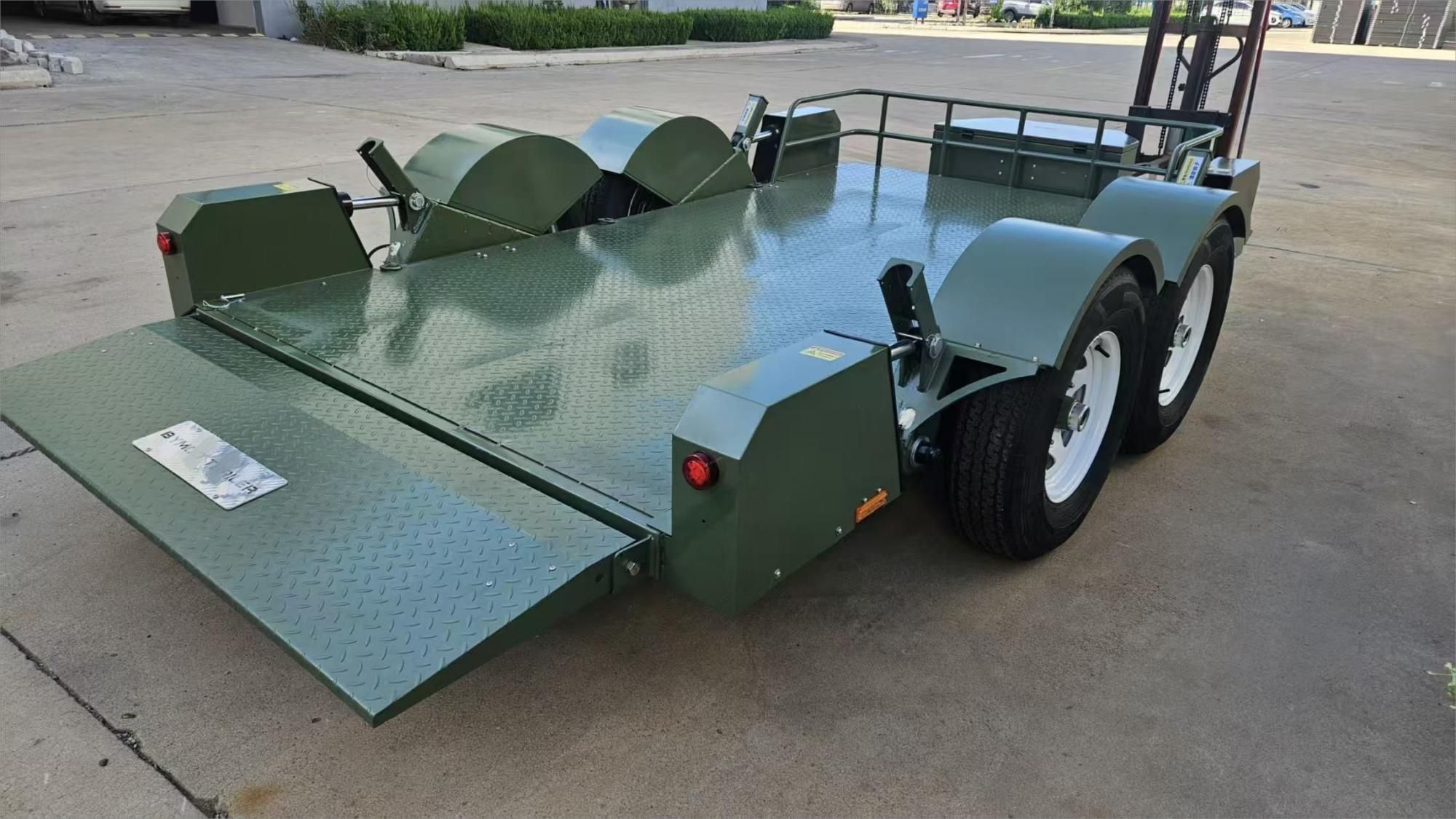
The dual axles spread the load across four tires instead of two, which calms sway and improves braking. The hydraulic deck does the heavy lifting, tilting right to the ground so you can drive or winch a skid steer aboard without fighting ramps.
Landscape crews, compact equipment rental yards, construction contractors, and small agricultural operations tend to run them daily. They are a practical fit for mini excavators, scissor lifts, pallets of block, and similar dense loads.
Instead of positioning ramps and working on an incline, the operator lowers the deck to ground level, loads, then raises the bed and locks it for transport. It saves time and cuts down on the strains that come from repeated manual lifting or ramp adjustments.
Look closely at weld consistency, frame reinforcement around the hinge and cylinder mounts, hose protection, axle and tire ratings, and the finish on the underside. A builder that is transparent about component brands and warranty terms tends to be a safer bet.
A 5-ton load puts serious stress on tires, bearings, and brakes. The second axle gives you four contact patches, stronger braking, more even weight distribution, and a safer margin if a tire loses pressure on the road.
It can, provided the operator pays attention to the lift mechanism and keeps the deck stable while raising or lowering. Soft ground calls for wider stabilizer pads or plates, and the trailer should be chocked before loading.
You are usually looking at a three-quarter-ton truck or larger with a properly rated hitch, trailer brake controller, and enough payload capacity for the tongue weight. The trailer itself may weigh around 2,500 to 3,200 pounds before cargo, so the truck needs real margin.
Grease the pivot and hinge points, check hoses and fittings for weeping, wipe down cylinder rods to prevent grit from damaging seals, monitor the pump and battery if the lift is electro-hydraulic, and touch up any paint chips before corrosion spreads.
Conclusion
The first time you load a five-ton dual-axle hydraulic trailer from this company, the rating stops feeling like a spec-sheet number. The frame doesn't flex or complain when a compact excavator rolls up the ramps, and the twin axles spread the weight so the trailer tracks behind the truck without the usual tail-wagging. The hydraulic lift is the quiet part that changes the day: instead of wrestling with jack stands or ramps, you lower the bed to ground level, drive on, raise it, and you're already strapping down while the clock still feels generous. Small details tell you the builder thought through real use—weld placement, hose routing, latch reach, and the way the fenders don't crowd the load.
On a long climb, the trailer doesn't develop that nervous sway that makes you keep checking the mirrors. The axles and tongue weight feel balanced, so the truck's power goes to pulling rather than correcting. Crosswinds push, but the deck stays settled, and in tight switchbacks the trailer follows the line without shoving the rear end wide. It's not a trailer that demands constant micro-adjustments. Instead, it carries five tons like a much heavier-built rig while staying easy to live with when the road gets narrow, the weather turns, or the job runs late.
Contact Us
Contact Person: Allan
Email: [email protected]
Tel/WhatsApp: +86 18227999576
Website: https://www.wholechaintech.com/